Thursday, September 26, 2019

Kriye


I don’t always sleep well when I’m in Haiti.  I don’t say that to complain, but as a mere statement of fact.  The beds are not luxurious, but they are a thousand times better than what most of the Haitians we are serving sleep on.  It is difficult to control the temperature; the city can smother you with heat and humidity while the thin mountain air can leave you chilled.  As I’m older I feel more aches and pains, which seem to be magnified with poor quality sleep.  And then there are the noises.  


Typical noises in Haiti can be Kampa music from a distant discotheque (Club Affeksyon is one of the best named ones I’ve visited).  The bar could be empty, but that won’t stop the owner from dropping dope beats through the aux cord ALL NIGHT LONG.  If it isn’t the beats, then sometimes it’s the ‘baaaas’.  I laugh at the customs form when re-entering the states as is asks if you’ve been on a farm or handling livestock.  Have you been to Haiti?  Anywhere but the city is agriculture and livestock.  Roosters, goats, pigs and dogs all like to make their presence known at all hours of the night.  Sunrise be damned.


On the morning of 9/17, though, there was different sound… a ‘kriye’.  We had had some deliveries the day prior, but none of the newborns had been noisy up to that point.  There were two pediatric patients in the hospital.  But, again, they had not made much noise in the days up to this point.  


I couldn’t sleep.  It was LOUD.  And it had been going on for over an hour straight.  So, I got up. 

She was outside the hospital… sitting in a chair… and she couldn’t have been older than nine months.  Her hair was in braids.  She had a dress on.  I looked around and there were several adults using the outdoor water supply to wash off their feet as they changed their clothes.  It was, maybe, four in the morning… maybe.  #EverythingBeforeSunriseIsFourAM I picked her up and I think the sheer shock of my whiteness plucking her off the metal folding chair stole her voice.  She stared.  I bounced.  Silence.  Perfect.


Her mother finished cleaning up and came and grabbed her.  About that time, she started crying again, but I at least satisfied in my mind the source of the screams.  I was up for good at that point, so I went into the post-partum suite to check on the moms and babies we had delivered.  When I passed back through the lobby of the clinic, I saw the little girl, her mom and her brother laying down on the bench to hold their spots for the day’s clinic appointments.   


I don’t personally see as many patients in the clinic as I used to.  I mostly go to observe clinic flow, provide resource support, trouble shoot and offer an occasional “this is how we would approach x/y/z in America”.  On this day I was observing in clinic when the mom brought her young boy and girl in to see Dr. Leo. Once again, my pale skin must’ve scared the little girl, or she was tired, or she was cold, or she was hungry because she immediately started screaming… no…crying – scryming?!?  I tried to hold her, but that was unsuccessful.  John, however, is the child whisperer and was able to bounce her around the clinic enough to keep her content.  


She wasn’t the patient.  Her brother was.  His body was skin and bones and his face looked beleaguered.  He was, himself, a child, but you could tell that he carried so much responsibility at his young age.  The little girl looked nine months.  She was fifteen months.  The mom’s concern was that the young boy had been coughing for over two months.  He was timid and often parroted what his mom said when Dr. Leo would ask a question.  Suddenly, Leo recognized the mother.  He confirms her name and turns to me, “we diagnosed her with TB last April.”  Yes, Tuberculosis.


She had gone to “the city” as a 16 year old.  According to Dr. Leo, she met a man and got pregnant.  As is all too common a tale, the man left her without concern for the well-being of his child or the child’s mother.  She moved back to Gran Bwa this past March.  She lives with her mom and tries to work as a seller in whatever market she can create an opportunity.   Even in better economic times, there are not a lot of opportunities in rural Haiti.    


I can’t say that I’ve seen a high volume of TB patients during my time in Haiti.  It isn’t the easiest thing to test for, so I may have started the work-up on some patients with breathing/coughing complaints that would eventually lead to a TB diagnosis.  However, we have a 20 year old mom of two with a known TB diagnosis.  The older child is here for a cough lasting two months and looks emaciated.  The 15-month-old has powerful lungs but is clinically malnourished.  Everyone needs treatment and fortunately there is a State sponsored clinic in the area with a TB program.  Yay! 

Jocelyne had been in treatment since her diagnosis in April.  One might think the system would take care to ensure close contacts did not contract this deadly bacterium, but alas here we are.  All we need do now is send our young man down to the clinic on a TB day to undergo sputum testing and enroll in the treatment program.  And fortunately, September 17th was a TB day!  We tell the mom to hurry, pack a quick sack with a little food for the trip, and grab a moto to take her to the clinic building.


This would’ve been too easy.  The protests, or #Manifestations, had started in Port au Prince and somehow had found their way up our peaceful mountain. Crowds flooded the city streets to burn tires and generally disrupt commerce.  Not with plans of violence, this time, but to cause a scene and be heard.  The same was true in the mountains.  Young men, and possibly women, set up “road blocks” along the one road that went up and down the mountain.  Jocelyne was stuck.  She couldn’t reach the clinic to get her son started on his life saving medication.  She returned to the clinic and they had to wait.


This is one of many “road blocks” this poor, young family is going to have to deal with just to treat this disease.  I mentioned earlier that when I found them originally, they were cleaning up in the water supply outside the clinic.  They had hiked several hours in the mud just to get to our clinic.  They had brought a change of clothes to ensure that they were clean and dressed well to see the doctor.  If I’m sick, you can bet that I’m rolling up to my doctor’s office wearing sweatpants and bags under my eyes.  


Several days go by and finally the mountain road opens.  They were stuck at our clinic the whole time.  I have difficulty with the clinic being treated like a soup kitchen, but in this situation even Scrooge would show compassion.  Charity is, to me, a very delicate and difficult act in Haiti.  With nearly every trip I have people offer to personally give me cash so that I can deliver “whatever they [Haitians] need.”  I always go into a trip not knowing what I will encounter.  Where will the money be best used?  This time, it was clear.  I spoke briefly with our Haitian social worker - who had already recorded as much information about this family as he could - and I told him that I had money to support this young mother and her two children.  I felt that we should buoy them as they tried to fight through poverty to treat tuberculosis.  The clinic will always do what is necessary to take care of patients, but I wanted Jean Louis to not have to worry about the funds coming from somewhere else.  


Their story isn’t finished.  Unfortunately, it is one lasting several months with frequent long trips to refill their anti-TB medication.  It is one lasting several years to fight through the cycle of poverty to have a sustainable income.  But I do think we offered this family a new chance at life.  For those that gave this trip, thank you.  Jocelyne and her young family have an opportunity to pursue life they would not have had without your gifts.  I cannot thank you enough.

Thursday, July 18, 2019

Akouchement Lakay

Since the @ServeHaiti Instagram post caught a fair amount of attention I thought I'd give the writing thing another shot.

I had returned to Haiti after being whisked away in a helicopter just two months earlier #Manifestations.  I'm still getting the feel for this whole Medical Director thing, but if it gets me into the beautiful country more then I support it.  ServeHaiti is piloting a new data collection program that will (hopefully) allow for near real-time information to be easily organized and analyzed.  We do (I say 'we', but it's definitely got nothing to do with my actions) amazing work in Grand Bois, but it's really hard to say those things without objective information.

That's why I'm here though.  Help introduce the program.  See it in action.  Troubleshoot early problems.  And obviously to work on my tan.  #BeachSeason.


The first day was great!  Abby and I were able to get the selected #CommunityHealthWorkers to the clinic and give them their "new" device.  And by "new" I mean four-year-old, generously donated, tablets running Android platforms.  But that's definitely #HaitiNew.  Even Dr. Leo and Jean-Louis (JL), our hospital social worker, were in on the fun.  The plans are to have our childhood malnutrition program data recorded, our pharmacy inventory, and then track the work of our community workers.  Abby was able to walk everyone through the sample templates so they could familiarize themselves with #Collect.


The following day we were off!  John, Abby, JL and myself hopped on motos and headed East!  Or North!  Or... I really don't know my directions when I'm down there and often feel like I'm going in circles.  Probably explains why my "short jogs" end up with me getting totally lost.  Riding on a little moto is exhilarating.  If you're able to pry your eyes away from the fractured, mud-gravel-dirt road directly beneath you and look outward over the sharp cliff to the beautiful mountains and valleys you'll wonder why more people don't tourist here.  Then you hit a rock, fishtail, and think WTF WHY AM I NOT WEARING A HELMET.

An hour into our ride we stopped at a crossroads to pick up another of the CHWs.  It was around 1030 but already the Caribbean sun was putting in work.  Silianette was out handling some local community meetings.  The plan was to pick her up and head to the far reaches of the Grand-Bois territory to see data collection in action.  I was pumped.  I was promised some good hiking.  The sun was out so the guns were out.  Fixing to be a great day.

Until


We're walking back to our motos Silianette tells me, quite plainly, "there's a woman in labor over there'".  They wanted "the doctor" to check on her.  When I get to the house I see this young woman laying on the floor, holding her pregnant belly, and another young woman sitting behind her so that she has somewhere to lean.  She was term.  First baby.  She had been seen in the clinic for her prenatal visits and had not had any known complications.  Her contractions started at 0400 that day.  WHAT?  G1P0 contracting for only 6 hours.  Give me a break, take two Tylenol and sleep it off.  I tell John that I'll make sure she isn't too far dilated, but that I think it'd be safest for her to take one of our motos back to the clinic and deliver the baby there.  6 hours.  G1.  #Laughable.  Silianette was able to grab some gloves from her house out of her CHW supplies.

"Okay, I'm going to need to help you up into this bed so I can check your cervix" doesn't really have great direct translation into Haitian Creole.  I think John basically said, "Get in the bed he's going to check your uterus."  Message delivered.  We help her climb off the floor and up onto the elevated mattress.  "A little pressure annndd…."  Oh boy.  My body language said it all.  Completely dilated.  Bulging and tense amniotic sac.  Still 0 station, but at this point I can't send her on a moto.  "We're going to be having this baby here".

I look at my surroundings.  Slabs of tin peppered with holes are over my head.  Around me is a network of sticks and branches held together with dirt.  The floor is dirt, tamped and swept smooth.  A straw mat and blanket are still on the ground from where mom-to-be had been sitting.  A child walks in carrying a plastic chair offering me a place to sit.  A neighbor picks up my backpack and sets it on a table in the adjoining room.  Clear off the schedule, we're gonna be here a while.

I step outside to discuss the plans with Abby and Jean-Louis.  I have hand sanitizer, my stethoscope, and Silianette's meager supply of nonsterile gloves.  Abby is quick to snap me out of my thoughts and keep me to task.  "Yes, we need a razor blade, two pieces of string, and boiling water."  Sure enough, within an hour Abby had sourced an unused razor blade and two eight-inch pieces of string, boiled them, and scooped them up each with a fork so that they could be kept sterile...ish.
Photos courtesy of @servehaiti on the gram


For anyone who has not had a baby it's a lot of misery and waiting.  I didn't know when my training might be helpful, but basically I was sitting around talking and thinking.  JL and Abby did take one of the CHWs to head off and start the data collection.  Silianette stayed close, but took the opportunity to survey some of the nearby houses.  John and I stayed in the house and learned about our 20 year old patient and her soon to be 0 day old son.  The father of the baby had left shortly after they learned of the pregnancy.  She had a strong support system including a sister whose toddler was absolutely petrified of me and a grandmoun who has had several of her own children.  A midwife may or may not have been notified, but was not nearby.

Her contractions started before the sun came up that morning.  Apparently, 4am is generic for "before the sun comes up".  It could have been 8pm the night before for all we know, but we know it wasn't light out.  I'm so used to having my patients walk in saying, "I started timing my contractions last night at 715 pm but they were only 12 minutes 32 seconds apart then, so I didn't come in, but then this morning at 2am I felt one that was extra strong, and I thought my water broke, but maybe I peed a little, anyways the contractions are 10 minutes apart and my doctor told me to come in if my contractions are less than 10 minutes apart. *breath* So, how far am I dilated?"  #FirstWorldProblems

I encouraged walking, but she didn't have the strength for that.  She tried to eat, but got sick.  We treated some water and flavored it with Mio.  That went down okay.  She was breathing through her contractions and cycling every 2-4 minutes.  Noon comes and goes.  I have a few breakfast bars in my backpack, so John and I each eat one.  A few of the kids running around outside share another one.  I ask to check if she's made any progress, but she really hasn't.

I manage to break her water.  Clear fluid.  Hopefully this show can get on the road.

And this is where the panic and worry start settling in.

I set my phone out and play some music.  At one point I had a "Push a Baby Out" playlist with Salt-n-Peppa, TLC, and Bieber, but I had to settle on whatever my Spotify favorites were.  I look at my patient and the emptiness in her eyes.  I look at my arms and my whiteness just glows in the dark hut.  If this delivery does not go well I worry what this might due to the trust and relationship our clinic has with the community.  Will I be blamed?  Will the clinic be blamed?  Such little control with so much pressure.

Another hour passes with her pushing with every contraction.  I try to tell her not to push, conserve her energy.  But you tell that to an unblocked pregnant woman and see what happens to you.  I check again and get a sense of position.  The baby is LOP and asynclitic.  We try the floor again on all fours to see if that's more comfortable for her.  Yes, the dirt floor.  Her prayers start flowing.  It's all rapid Creole, but I've heard them enough times to get a sense of what's being said.

She gets back into the bed.  I check and we haven't made much progress.  With her next contraction she pushes and I try my damndest to turn the baby's head using just my fingers.  I have no way to assess fetal heart tones so every moment she's still pregnant is just taking years off my life.  And yes, I know they aren't sound science, but when you've trained having that information most of the time then not having it is anxiety-invoking.  Back to the floor.

Progress!  We've delivered hair!  I get to make the joke that all his hair slowed him up!  It gets about as many laughs as you would expect.  She's tired and over it.  She makes slow and steady progress with each contraction now.  The baby's crowning.  Her pushes are near continuous, but she's running out of steam.  I have her family help support her legs as I kneel on the dirt floor heart pounding.  "Please God, healthy baby.  Please God, healthy baby."

The head delivers and he's facing left.  Shit.  Tight nuchal cord.  I grab for it and try to tell her not to push.  I can't clamp and cut.  It's tense.  I don't think it would allow us to deliver through.  With my second quick sweep with my left hand the cord slingshots from around his neck.  Oh thank God.  Head down.  Shoulder.  Back up.  Grab the legs.  POOF!  Baby boy followed by a pile of poop.  No screams.  No tone.  I grab the string and fumble through tying my long-forgotten surgical knots near the boy's umbilicus.  Then another knot a few centimeters away.  No time for theatrics.  Grab the razor blade and put the business end against the cord.  Saw away.


Separated, I turn to the bed behind me.  My internal clock is both at zero seconds and a thousand seconds right now.  Towels.  Dry.  Stimulate.  I throw my stethoscope down... *bump * bump *bump * bump... right about the rate of a catchy pop song, so probably 120 BPM.  That's good.  Still don't see a lot of chest rise.  I tell John to continue to vigorously dry the baby with a fresh towel as I tilt his head.  No suction bulb, of course.  Stethoscope back to the chest... same pace.  No movement.

Seconds.  Minutes.  Who knows.  I don't know about NICU attendings, but anytime I find myself in this situation I feel like I'm all alone and I have zero concept of time.  Stimulate the body.  Support the airway.  Pump the legs.  I'm almost about to lift him by his heel and slap his but when suddenly he sputters out series of coughs.  Quite possibly the most beautiful sounds I've ever heard.  I let out an audible sigh.


He's breathing.  His skin slowly pinks up.  And here comes the crying.  I swaddle him and try to bring him to mom.  She's not having it.  Sister grabs him up and the rest of the family swarms her.  I kneel back at mom, still on the ground, and twirl the umbilical cord around my right index finger.  It comes easily.  Seems to be intact as I inspect it on the straw mat.  I'm not sure why but I do brief exam for lacerations or brisk bleedings.  For real tho, what am I going to do?  She has a small side wall laceration, but no deep perineal laceration.  I apply a piece of gauze and hold pressure.

It's done.  We have a crying baby.  We have a mom who is standing up to put on underwear.  We have an excited family rushing into the "delivery room".  As I walk out the sun still hits my eyes.  It's 4pm.  I have John give Silianette instructions so the mom and baby will follow-up in the clinic tomorrow.  Instructions if she has any further bleeding.  Encourage her to breast feed as much as her body will let her.  We say our goodbyes.  Eat a small amount of the food they offer us.  But the rain is coming and our moto driver wants us to get back.

Near perfect timing, Jean-Louis and Abby arrive at the crossroads at the same time we do.  We course back across the Haitian landscape as storm clouds gather overhead.  Back at the clinic we pay the drivers and find our food waiting for us on the dinner table.  The rain falls as the sun fades away.  The raindrops echoing off our tin roof with authority.  The rain is welcome to the drought-stricken area, but I can't help but think of that tin roof sheltering that brand new baby.


Tuesday, June 19, 2018

Love in the time of Cholera

Do you remember the SNL bit commercial for  "Oops! I crapped my pants!"?  Well, I do and it was hilarious.  When it first came out I was in 7th grade (back when SNL was still entertaining).  I thought I was long past the time of worrying about crapping my pants - or at least until I caught up to my dad in age.  Turns out, that wasn't the case.

When it comes to my travels in Haiti, I'm not the most careful.  I've eaten my fair share of "street food".  And... tbh... I don't see much different between the street vendors in Haiti and food trucks in the U.S.  Well, other than a health code I suppose.  I buy fruit and veggies from the market, and then eat them after a quick rinse.  I'll utilize the available filtration systems and water delivery relied upon by the locals instead of purchasing purified water.  And I tell myself I do this because "if it's 'good enough' for the Haitian locals, then it's good enough for me."  My GI tract must not have gotten the memo, or perhaps it did.

It was the spring of 2013 and I had just received my diploma from medical school.  I co-piloted a clinic team that hiked up to a church building in rural Haiti to deliver medical care.  The trip had plenty of ups and downs.  If we're talking about the hike, then I would say we went up and down three mountains (but who's counting) in each trek of the hike.  If we're talking about my relationship at the time... then probably more.  But we survived (the medical team and my relationship) the mentally and physically exhausting trip.

An amazingly rewarding experience to deliver medical care to this rural community.  I won't sit here and defend the merits of delivering healthcare to a community for four days and not return, because there really is no defense.  However, the trip was more of an exercise in logistics and feasibility if I'm being honest.  The sustainability part was to follow, but plans and priorities change (and vulnerable populations suffer).

But we were back in our cozy, Coralville apartment.  The trip was complete.  Unpacking had yet to start, but there'd be time for that.  We had a big weekend coming up, after all.  What had originally been planned as a Haiti fundraiser ended up being downgraded to just family and friends coming up for sand volleyball and a few beers.  There may have even been a planned "table-topping" into "You Lost that Loving Feeling" into a proposal, but something happened.

The trips to the bathroom woke me up in the morning.  And I couldn't stop.  I was having more than four stools an hour and by the time noon hit I had gone to the bathroom nearly a dozen times.  If you want to google "rice water stool" you can get a sense for what it looked like...  An infectious disease doctor I work with now and have a tremendous amount of respect for remains skeptical of my self-diagnosis of cholera.  But, had I seen a patient in Haiti with my history, knowing that it had reached epidemic proportions with the rainy season, I would have arrived at the same clinical diagnosis.


I tried to keep up with my oral intake.  I was chugging Gatorade and water and Pedialyte and truthfully anything I could to keep up with my ongoing losses.  I tried Immodium to slow down the process, which worked a little.  I thought, "Hey, maybe I can go join in on the fun with my GF and her friends playing volleyball."  I even changed to head that way.  But then I started walking down the steps... and I wasn't as ready as I had thought.  Sooooo, it happened and I had to bail on our plans for the day.  And it was a sore subject.  Another fracture in the foundation of love that led to the demise of a promising relationship.  But how do you tell someone you had an accident like that?  You don't.  You keep it locked up deep inside of you until you finally have to write a blog post about ongoing issues with cholera in Haiti.


Unfortunately a new outbreak has surfaced starting this past weekend.  The clinic I've served at (aptly named ServeHaiti) has been forced to put its cholera treatment tent back into use.  It also has converted a newly built "waiting pavilion" into a cholera treatment center to house the patients surviving the hike to the clinic.  We've already had two deaths at the clinic, and reports of several more that could not make it.

Worth noting that the clinic is a car ride followed by a 4-5 hour donkey ride from the source of the outbreak, so how many patients are stuck in rural-er Haiti unable to receive medical treatment?


By day two of my illness I was dehydrated.  I was having fevers and chills.  I had cramps so bad I couldn't eat and I'd vomit anything I tried to drink.  I gave up trying to do it the "Haitian" way.  I took full advantage of my white American privilege and my mentor at the time brought two bags of IV fluid to my apartment.  My body was like a vacuum.  The bags were empty in less than 30 minutes.  No pressure needed.  I took antibiotics, Zofran and a steady dose of AC to keep cool from the Iowa heat.  I didn't even have to face the embarrassment of going to the world class institution that is the University of Iowa Hospitals and Clinics to receive treatment.  I didn't have to admit to having an illness that literally made me crap when I walked.

The people of Ma Georges face the harsh reality that help is not nearby.  No girlfriends and mentors with IV catheters and sterile tubing.  No Walgreen's with shelves upon shelves of prepackaged rehydration therapies.  No toilets to flush away the evil and send it to a processing center.  They're at the mercy of the elements for their water supply and sanitation.  And it's probably the privilege in me that causes me to say that I'm not sure who feels more powerless.


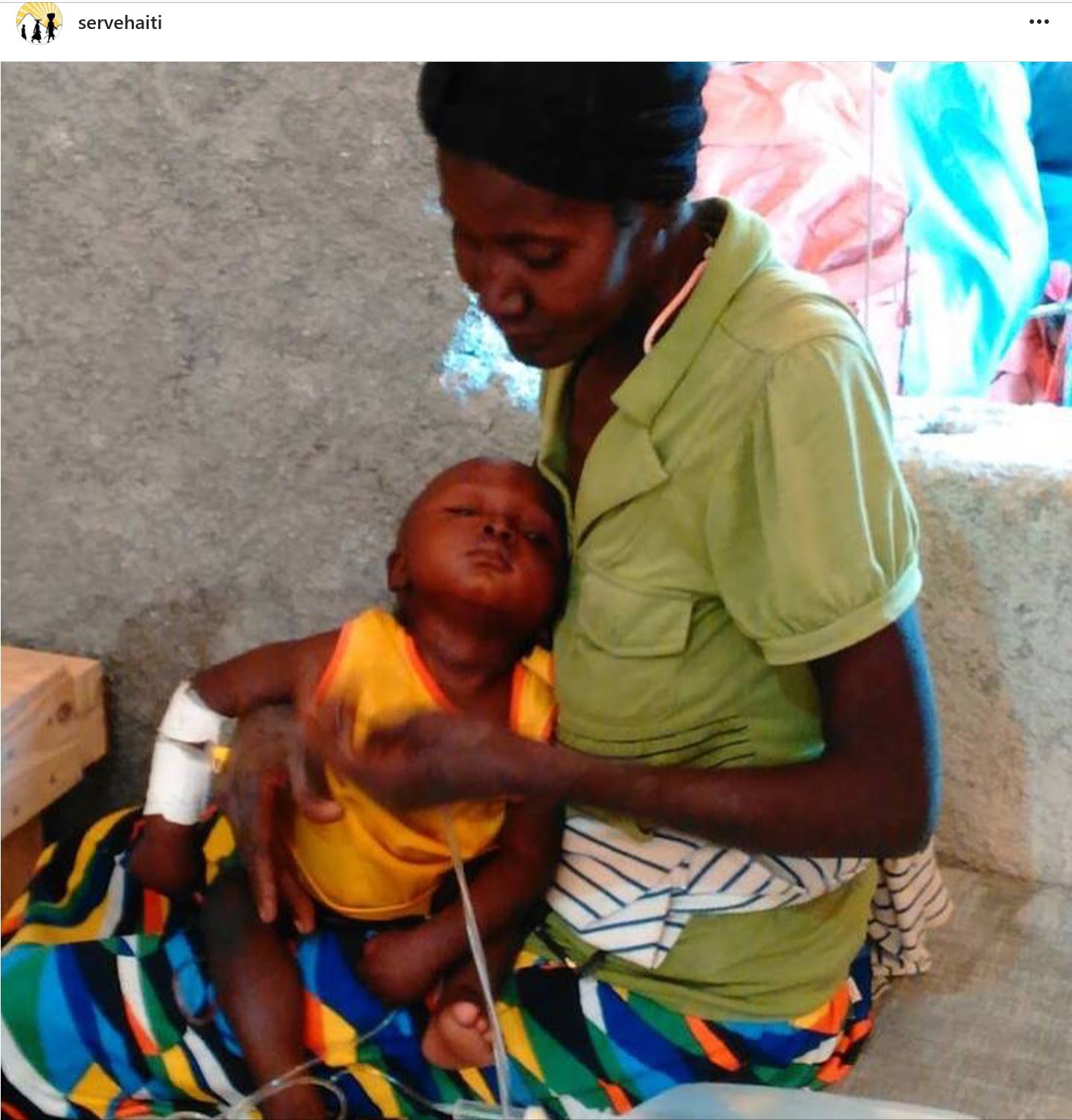
 I encourage anyone interested to follow @ServeHaiti on social media platforms for updates on the #Cholera #Outbreak.  That's where these photos are from.


Friday, February 9, 2018

Konten


This last trip a volunteer asked me how many times I’ve traveled to Haiti.  I couldn’t answer them.  I ballparked the answer as somewhere between eight and twelve.  Some trips longer than others.  My comfort with Creole also variable.  My destinations change.  I’ve visited during my various stages of education.  There have been trips where I’m so far removed from my faith I might’ve spontaneously combusted walking into a church.  More recently, that has flipped to where I lean on my faith because I have learned that so much healing is beyond my control.  You know how frustrating that is for someone with as big of an ego as me?!?!?!  No matter the settings or situations I’ve felt like Haiti “helped me” much more than I helped the people I went to “serve”. 


I typically use this blog space to discuss clinical care for a patient encounter, but truthfully this most recent trip had very little of that.  And it may have been my most rewarding trip yet.  And I don’t say that to discount my other experiences, but my mentality was so different this time.  First, I was leading a bunch of other blan for the first time.  Second, I really separated myself (some) from the clinical and focused on the people.  And I was filled with joy.

One of the unique aspects of the St. Vincent de Paul clinic in Gran Bois where I was working is that it is basically one game of “Red Light… Green Light” away from the Dominican border.  No passport needed.  If anyone follows my other social media efforts you may have seen pictures of the stone marker denoting where Haiti transitions into the D.R., or even the photo of my phone getting confused and welcoming me to Vietnam.  #TrueStory  #GoHomeSiriYoureDrunk

Naturally, it’s a neat group activity to take a team of newbies on a hike and go to the “border”.  Then we get to take the standard photos of people “straddling the border” or waiving to each other from “different countries”.  Yes, everyone who travels to Haiti is a nerd, or at least they must pretend to be one when they travel with me.  #DealWithIt 

It was Sunday and we had a pretty eventful day - a two-hour church service (more on that experience on a later date), a walk through a bustling market, a sampling of fresh sugar cane, a soccer game, and so on and so on.  But, later in the afternoon and after our 3 pm “dinner” was settled I rounded up the crew to “hike to Dominica”.  Everyone put on their Dri-Fit tops, athletic shorts or gore-tex hiking pants, and Merrill hiking footwear to get ready for the trek.  Needless to stay, our (my) pasty-white skin and fresh, name-brand threads stood in stark contrast to the collection of kiddos that decided to follow us on our hike.  #ThisIsNotACallToDonateClothing

It was going great.  We had one good incline that made you kind of feel like Rocky when you got to the top.  But of course the kids dominated it like it was nothing.  #AltitudeTraining #HaitiFit  The climb was early in the hike, at least, so the rest of the time we could enjoy the amazing views from a relative highpoint. 

Some stumbles.  No falls.  Some poop dodging.  “Oooh’s” and “Ahhhh’s”.  And arrived at the marker.  There’s a peace at the top of a mountain in Haiti that is impossible to put into words, even when you’re surrounded by a thunderous herd of little boys.  Come with me some time and I’ll prove it.  Then you can try and put pen to paper.  Photo after photo after photo snapped trying to capture the majesty of the setting sun over mountain tops with lakes in the valleys.  Bob Ross would stay and paint for days.  But, days we did not have.

Haiti is on the CDC travel advisory warning list.  Recommendations are not to be out after dark for safety reasons.  Security in the country is sparse.  As a foreigner you are warned that you could be targeted.  Well, objective numero uno for this boss was to keep everyone on the trip safe (unless you count letting them ride on motos).  So, as I could see the sun was setting I had to break up the four hundredth photo “straddling” the border to encourage us to head back. 

We took a slightly longer way back, but one without as many steep climbs or descents.  Still copious amount of fecal material on the trails though, don’t worry #NameThatPoop #FunGame.  As the sun sank further several of the community boys ran ahead of us heading back home.  And then it struck me, they probably had a curfew.  How silly is that of a “eureka” moment?  Oh yeah, these little children are probably not supposed to be out after dark - especially with a bunch of foreigners.  I wonder if their parents are gonna ground them for being home late.  Is it weird that I, for some reason, figured those cultural things were exclusive to our over-protective suburban, “Wonder Years” families? 

As we sauntered on we all became engrossed in our steps.  It was dark.  The paths were made of rocks and dirt and poop, so no step was to be taken for granted.  The moon was coming up but by this time we were between peaks.  We were passing people, likely on their way home from a day of work or even a late Sunday church service.  The path narrowed and was flanked on either side by tall, thick bushes.  And my worst fear became a reality. 

The screams were reminiscent of a ferocious charge during a military battle and they seemed to surround our little party.  Panic was immediate as eyes quickly darted and tried to adjust.  Fight or flight causes your pupils to dilate so more light gets to the retina.  And what did we discover?  That those little shits had set up an ambush!  They hadn’t run home to beat curfew!  They just wanted to scare us!  And scare us they did!!!  I think one of the volunteers might’ve peed a little.  Terror turned to pure hilarity as they laughed and laughed and laughed at the jumpy blan. 

They were so proud.  And so much like little boys in the states.  Ornery little devils that were just up to mischief.  Oh, and they weren’t done.  They performed the same trick TWO MORE TIMES to us as we finished up our hike.  But, I wasn’t about to let them have the last laugh.  I caught a glimpse of a rock sliding and then a shirt trying to hide behind a mound of dirt.  They had laid their next trip… I made my move.  I swung around to the left to try and outflank them.  My long strides were lucky that they found true footing as I quickly ascended the large dirt and rock pile. 

I went for it.  “Ahhhhhhhhhhhhhhhhhhhh” as I wildly swung my arms in the air and closed the remaining steps to their secret location.  And they erupted in shrieking giggles as they scattered.  They scurried every which way, their smiles nearly glowing in the waning daylight. 

But the final word would not belong to the blan… A few of the boys set up one final trap for us as we were getting ready to turn back towards the clinic.  It was a fantastic cap for an eventful day.  A day disengaged from the clinic.  A day where we just went into the community to be among the people.  We attended church.  We participated in commerce.  We played Sunday futbol.  And we were the source of entertainment for a gang of mischievous boys.  I felt a sense of contentment and belonging that I can’t say I had ever felt just working in the clinic. 

Friday, February 2, 2018

Grief (The Story of Mirlande)

On an earlier visit to Haiti, I was fortunate enough to be invited to an “English Club”.  No, it was not an elitist club created for and by the blan, but rather a group of Haitians that would meet and practice their English.  It was fun!  They’d propose a topic and have philosophical discussion, in English, about it.  I quickly found that I wasn’t necessarily there to participate in the conversation, but more to help their pronunciations #StillAnOutsider

One such meeting took a turn I would have never predicted.  The topic was depression or, more specifically, “Who was more depressed – Haitians or Americans?”  Wow.  Let that sink in.  It seems so trivial, but then it starts hitting on so many different levels.  To me, at first, it was a no brainer.  I offered than in my brief (especially at that time) medical service in Haiti I very rarely came across patients whom I thought would meet criteria for depression using any sort of scoring system.  However, in the U.S. I feel like MDD is one of the more common diagnosis codes that end up in my notes.  Diabetes Mellitus Type II. Morbid Obesity. Major Depressive Disorder #TrendMuch?  I was hooked to the conversation.

In the group, the overwhelming response was that Haitians were more depressed.  I mean, they would HAVE to be, right?  Half of the morning in rural Haiti is spent getting water.  Most don’t have steady employment.  Food insecurity is common.  Infectious disease and trauma are daily occurrences.  This conversation was just two years removed from the Earthquake that claimed hundreds of thousands of lives and unquestionably impacted every single person in Haiti.  Plus, it was hot as hell where I was and there were no AC units to be found #FirstWorldProblems.  How could you disagree with their argument?!?

It stuck with me.  Mental health is a wholly under-represented field in low-resource countries.  Somehow, my friends at Respire are accomplishing the impossible by offering mental health counseling to their students.  The results and stories are both sad and amazing.  But it wasn’t until I was on this most recent trip to Gran Bois with ServeHaiti that I realized how vital this service is to community wellness.  (I hyperlinked to both organizations' websites if you want to see more about the awesome work each are doing or are interested in donating time / money / goods).

The story was sad.  A 6-month-old was brought in by her father because he couldn’t get her to eat anything.  She was laying in our hospital crib covered by a tattered blanky.  The kind of tattered you’d expect next to a toddler that just didn’t want to let go of their baby blanky.  Her brown eyes wide open and just piercing through me.  No smile.  No tears. 

The dad didn’t offer much for nonverbal cues as I began my infant exam.  That’s when we went from sad to tragic… “The mother had been working in the garden when a rock fell and hit her head and she died.”  Hold up.  Imagine, real quick, that you’re hunched over a 6-month-old auscultating her heart and trying to get any kind of reaction out of her with silly faces.  Then your interpreter drops this bombshell on you.  A monotone, run-on sentence that punches you right in the gut. 


“Wait…. What??”  “That’s what he said.  The mother was working in the garden when a rock fell and hit her head.”  “When did it happen?”  “Last Friday.”  It was Wednesday.  The girl hadn’t eaten anything in six days.  The staff at the clinic had started her on Plumpy Nut RUTF and Oral Rehydration Syrup as well as a vitamin regimen and some antibiotics for kicks. 

Powerless is seeing a problem and not being able to provide a solution to it.  And boy did I ever feel powerless.  Her problem extended well beyond any physical ailment.  She was grieving.  I imagine she was confused.  She needed to be nurtured.  Held.  Breastfed by her mom because that’s all she knew.  The father needed counseling.  How the hell does he deal with this?  Single parenthood is tough in the states (speaking not with personal experience), but I can’t even try and relate it to rural Haiti.    

It was a heavy reminder to me that mental health is more than just depression and “feeling the weight of sadness” as it was once characterized in a Zoloft commercial.  It’s about grieving.  It’s about coping.  Addressing PTSD.  It’s about the mind working through problems that modern medicine struggles to define let alone treat.  It’s about a community that doesn’t isolate a patient struggling with bipolar disorder or schizophrenia like they’re a crazy demon.  It’s about a healthcare provider who realizes that alcoholism and addiction can’t be treated with a pill or incarceration.  These treatments often require deep, interpersonal relationships, trust and a spiritual healing.


The first photo is her on admission and the Facebook image gives a little more background into some family dynamics from a couple of other volunteers.  This picture is her after ten days in the clinic.  Thank you to Liz McDermott and Sarah Stafford for the updates.
I don’t yet have a conclusion for the little girl’s story.  I hope the ending is far away and happy, but I fear the worst.  Even in the U.S. a tragedy like this would be very difficult to recover from.  They were the last patients I said goodbye to on my way out.  Her eyes still wide and vacant.  His eyes confused and full of fear.  I think I speak for the whole team that saw them when I say their faces will never leave my mind.

Monday, February 27, 2017

Blan

Have you ever seen the show, “The Whitest Kids You Know”?  It may have been inspired by me.  I seem to typify every “white” thing in both appearance and activities.  I listen to Kanye and can rap several of his songs at the drop of a dime, but secretly enjoy T-Swizzle and definitely had her back when the two of them were beefin’.  I use the word “beefin’”.  I pretentiously drink microbrews when I go to the bar.  I think it is our moral obligation as a nation and as individuals to support those less fortunate. 

Probably the one “white” thing that doesn’t resonate with me is running.  White people love jogging, or maybe it’s ‘yogging’ #WithASoftJ.  My dad was an avid runner participating in marathons through most of my childhood.  I suspect if I were to take it up I might be decent at it, but it’s not my thing.  Hell, I should probably give my menisci to my dad as he’ll get more out of them than I will. 

Except of course, when I’m in Haiti.  I have no idea why but I enjoy running the foot trails along and up the mountains in Gran Bois.  Maybe I just really like stepping in shit.  Maybe I like tumbling down a mountainside while all the Haitian children laugh.  I definitely like the scenery.  I’m not sure God has created more beautiful and scenic views than in Haiti #SorryNotSorryTwinPeaks.  I try and take pictures, but I give up because there is no way they can match the en vivo experience. 

My first full day in Gran Bois, after a long clinic day and after a large “supper” I opted to throw on the tennies and head off on the trails.  Again, pretentious white person, I was jogging in an Under Armour dri-fit t-shirt.  Bright red.  Hard to miss.  I took off on the paths up the nearest mountain.  Familiar trails turned unfamiliar quickly, but “deciding where to go” was just a break in disguise.  And I’ll cop to it, the rice and beans tasted way better the first time than the second…

I made it back to the clinic and then headed off in the other direction.  I had hoped to catch a group headed on a hike to the Dominican border, but just ended up wandering down new paths and scoping out new mountain top views.  My story nearly took a sharp twist as I was passing a man guiding a bull down one of the footpaths.  Standard procedure is to speak some salutation to anyone you pass.  Even if you don’t stop to engage in conversation, they’ll be much more pleased with you having heard you wish them a “Bon swa”.  So I take to the left edge of the path as I pass the man and his beast and I finish my greeting I catch the bull lowering his head and taking aim at the gorgeous, red shirt adorning my chest.  I about face planted in a pile of donkey shit jumping out of the way, but the man was equally quick with his switch and got his bull in line.  A friend of mine always said, “If you mess with the bull, you’ll get the horn.”  I pert near got both of them.

Undaunted, today I took off in another direction.  So as not to become a target for any livestock, and obviously to work on my tan, I ran sans shirt.  With my headphones on I can block most of the calls from off of the side of the road.  A quarter of a mile from the clinic I ran by a cock fighting ring.  If I had had any cash moneys on me I would have stopped to gamble a little, but alas I kept running.  I found an incline with stairs carved and molded into the side.  And this led me to more and more steep hills that led up to one of the higher mountain tops around us.  Again, several “deciding where to go breaks” were had.  When I arrived at the summit of the trails I stopped to take it all in.  Gorgeous.  Amazing view of the entire country side including a speck in the distance that was the medical clinic. 


Suddenly I was approached by three school children.  One actually had his language book out and was practicing his speech.  I wasn’t running, so I took out the headphones and did my best to engage them in conversation.  I knew I wasn’t the first white person they had seen, but I may have been the first “red neck”.  I could already feel the slight burning sensation on my skin that likely meant my color was already changing.  We went through the basics.  Name.  Age.  Grade in school.  No I’m not German.  Yes I was staying at the clinic.  No I didn’t know where I was going.  No they didn’t know who lived in the small hut at the very top of the mountain we were standing on.  The back and forth continued with several pauses and “M pa konpren’s”.  But my stomach was telling me it was time to get back, so I offered my parting words.  They smiled and laughed and said several things back and forth that I could not catch.  However, looking around as the sun was fading I can imagine only one thing.  “We are disappointed.  We thought you would stand at the top of this mountain and give the valley ‘daylight’ for a few extra hours tonight.”  #ThatWhite

Wednesday, February 22, 2017

Death Summary

The patient was a pleasant 72 yo f with a PMHx significant for HTN.  She had initially presented to the clinic for follow-up after several months of being without her anti-hypertensive medication.  She was started on oral medication and dismissed home.  As she was leaving the clinic she began experiencing unilateral weakness on her R side and an inability to talk.  Her family quickly realized something was wrong and brought her back into the hospital.  Her exam was consistent with a dense L sided MCA stroke.  tPA was not given as it has at best questionable science behind it.  Also we have no CT scan or the actual drug itself.  Aspirin was administered rectally and the patient was left to recover in the hospital.  Unfortunately, the patient’s blood pressure became increasingly difficult to control and the patient went on to have a generalized tonic-clonic seizure.  IV Diazepam was given and she had no further seizure-like activity.   Plan of care and prognosis were discussed with family.  Without aggressive treatment of her blood pressure (250/120 and up) with IV medication, imaging to truly identify the magnitude of the lesion and eventually a feeding tube to help with nutrition, then the scope of her disability and chances of her recovery were both grim.  The family elected to keep the patient in the hospital.  While the patient showed no outward evidence of discomfort she continued to decline until she passed away on 17/2/17 at 1700.  She was surrounded by a large cohort of her friends and family.

This is a death summary.  Every individual who passes away in a hospital setting receives one of these.  They are cold and “factual”.  And honestly, the one above has more detail than any others I’ve read or written.  Covering an inpatient hospice service, I’ve gotten kind of used to writing a death summary.  Covering an inpatient stroke service also means I have seen those sorts of devastating strokes before.  They’re horrible, awful, terrible things.  We have little treatment for them.  Our main hope is to prevent them.

And that’s the kicker in Haiti.  Primary prevention of medical illness (i.e. preventing the first stroke or the first heart attack) is incredibly difficult.  In speaking with Dr. Leo after this woman’s passing he was quick to point out that her case should be a beacon to the community for why it is so important to treat tansyon oh.  However, he said that the people will say, “Oh she shouldn’t have crossed *that road today” or blame it on other superstitious things.  Maybe her family was “cursed”.  Maybe she crushed the wrong plant as she was hiking up the mountain to clinic.  Seriously, this will be how they explain her death.  Sidenote, having walked from the road to this poor woman’s house I’m surprised she didn’t have her stroke en route.  It was a very steep climb.

Death means so many things in Haiti.  I’ve seen new moms stare blankly or even with some semblance of relief when I’ve told them their newborn passed away.  This woman had “eaten a lot of salt” and there was nearly a riot in the hospital there were so many people clamoring to display their distress over her passing.  Also, how ironic is the “eaten a lot of salt” metaphor for a person being in their older age?  Especially when diseases related to hypertension are likely one of the, if not the most, common cause of death in that population. 

A small contingent of blan from the clinic attended her funeral.  Her daughter has actually been on staff at the clinic for several years, so the family was part of the clinic family.  I didn’t know what to expect.  I figured there would be a fair amount of wailing and shouting, which there was.  I figured there would be a lot of singing, which there was less than I would have guessed.  I figured there would be a collection passed, which there was not.  And I figured it would be at a church, and this was at her home.  Her grave was dug behind her house.  Apparently you have to be a member of the church in order to have your funeral at the church and to be buried in the cemetery.  I remember from before; death in Haiti is big business.

We stayed in the back so as not to generate a large distraction from the proceedings.  Soon I was surrounded by a puffs of smoke.  A group of older men had gathered behind a wall of her house to smoke cigarettes and drink moonshine.  They were laughing in conversation with each other, and I can only imagine that they were sharing loving stories about the recently departed.  Everyone handles death and grief differently, so I’m not going to question their actions. 

As the ceremony closed, the procession was led by two small children carrying a beautiful wreath.  Pall bearers took their place and the casket was carried past us and they began the descent down the steep, slick path leading to the grave site.  They struggled.  It was narrow and the embankment was steeper still.  Thankfully the casket never fell, but there was a steady rotation of men jumping in to help out.  My interpreter, John, was quick to lend a hand.  He had revealed to me days earlier that his father had passed away in the week before my arrival to the states.  He too had had a stroke.  I can’t even imagine how difficult the entire course of events was for him, but his focus was entirely on the family of this decedent. 

The casket was lowered and covered.  The family returned to sit and receive those who came to pay their respects.  Mwen desole pou ou.  Hugs and tears and hugs and tears.  But there was beauty in the grief that I can’t explain.  And as we began our long hike up the steep mountainside to the road we were able to reflect on just how intimate the event was that we had just attended.  This was a deeply loved woman from the community and we were welcomed as family because they knew we had loved her too.  While she passed under our care, we had shown compassion and had offered all of the treatments available to us.

It goes to show, even when you can’t fix, even when there is a potential for fix but maybe not immediately available, even when you’re delivering a message as grim as the one I had to, if you do the small things with great love then people will find comfort. 


Her body was released to her family for burial at home.  This is Dr. Matt Downen dictating death summary on ……. Thank you.  End dictation.